
What if you could watch anything you want, anytime you want, on any screen in your home?
Television has changed. It’s no longer about fixed schedules and limited channels. The modern way is through your internet connection.
This method delivers a vast library of content directly to you. You get live TV, movies, and shows on-demand. It’s a flexible service that fits your life.
Your viewing experience becomes personal. You control the schedule. The quality is often in high definition. This guide will show you how to unlock it all.
We will walk you through choosing the right provider and setting up your system. You’ll learn how to access the best content and services. Get ready to transform your home entertainment.
Key Takeaways
- Modern television uses your broadband internet for delivery.
- You gain access to a huge on-demand library of shows and movies.
- Watch live TV on your phone, tablet, computer, or TV.
- This service gives you complete control over your viewing schedule.
- A good provider ensures high-quality streams with minimal buffering.
- This guide is your roadmap to a superior entertainment setup.
Introduction: Unlocking a New World of Television
Gone are the days of being tethered to a broadcast schedule for your entertainment. Television consumption has evolved from a passive activity into an interactive, on-demand experience. You now have the power to choose what, when, and where you watch.
This shift is driven by your desire for true control and personalization. Traditional cable and satellite packages often fail to deliver that. They come with high monthly fees, rigid channel bundles, and limited flexibility.
Modern solutions use your existing internet connection to deliver media directly to your screens. This method, known as internet protocol television, represents the next logical step. It aligns perfectly with how you live and consume content today.
Why Your Viewing Habits Are Ready for a Change
Think about your current TV setup. Are you paying for hundreds of channels you never watch? Do you miss shows because they air at an inconvenient time? These are common frustrations with old-school services.
Your lifestyle demands flexibility. You want to watch a movie on your tablet in bed, catch up on news on your phone during lunch, and enjoy a live game on the big screen. Fixed schedules and single-location viewing don’t fit anymore.
Furthermore, the content you love is more global than ever. You might want access to international sports, films, or news channels. Many traditional providers have a very limited selection in this area.
The change isn’t just attractive; it’s necessary. The limitations of cable and satellite—high cost, lack of personalization, and outdated technology—create a clear need for a better way. This is where modern streaming services come in.
They offer a vast library of on-demand content, live TV, and niche programming. You get to tailor your experience completely. Your viewing habits are ready because you already expect this level of control from other digital services.
What This Guide Will Help You Achieve
This comprehensive guide is designed to be your roadmap. We will walk you through every step, from understanding the technology to enjoying a flawless setup. By the end, you will be equipped to transform your home entertainment.
Here are the key objectives we will cover together:
- Understand the Technology: Learn how internet protocol television works in simple terms. We’ll explain the core concepts without confusing jargon.
- Choose the Right Provider: Discover how to evaluate different services. We’ll show you what to look for in channel lineups, streaming quality, and pricing plans.
- Set Up Your System: Get clear, step-by-step instructions for installing iptv services on your smart TV, streaming devices, computers, and mobile phones.
- Optimize Your Experience: Learn pro tips for enhancing video quality, organizing channels, and using features like catch-up TV and DVR.
- Solve Common Issues: Gain knowledge to troubleshoot problems like buffering, connection errors, and guide malfunctions quickly.
- Stay Secure and Informed: Understand the legal landscape and how to protect your privacy and data while using these services.
You will learn how to access a world of content, including live events and vast on-demand libraries. This guide empowers you to take full command of your entertainment using the internet connection you already have.
Let’s begin this journey toward a superior, personalized television experience.
What Is IPTV and How Does It Work?
A revolution in home viewing is built upon the reliable language of internet protocols. To understand the power at your fingertips, you need to grasp the basic technology behind it.
This foundation explains why your experience is so flexible and high-quality. It also clarifies what you need from your home setup.
Defining Internet Protocol Television
According to global standards, Internet Protocol Television (IPTV) is defined as multimedia services delivered over managed IP-based networks. This includes video, audio, and graphics.
The key is “managed.” This often means a telecom provider ensures quality and security. It’s different from standard internet video.
This service is distinct from over-the-top (OTT) platforms you might use. While both use the internet, OTT services are delivered over the public web. A true internet protocol television service often uses a private, managed network.
The Core Technology: Streaming Data Over IP Networks
Here is how the magic happens. First, video and audio are compressed into efficient digital files. These files are then broken into tiny data packets.
These packets travel across your internet connection using specific rules, or protocols. Key protocols manage this delivery.
- Internet Group Management Protocol (IGMP): This manages “multicast” groups for live TV. It efficiently sends one stream to many users at once.
- Real-Time Transport Protocol (RTP): This handles the actual media delivery. It ensures audio and video packets arrive in sync and on time.
There are two main transmission methods. Multicast is for live television channels. Unicast is for video-on-demand, where a unique stream is sent just to you.
To watch, you need a device to decode these packets. This is often a set-top box or a compatible app on your smart TV. The device reassembles the packets into the smooth streaming content you see.
Understanding this process highlights why a strong, stable connection and sufficient bandwidth are crucial. It’s the technical backbone that makes your personalized television experience possible.
IPTV vs. Cable and Satellite: Understanding the Key Differences
The core difference between new and old TV services isn’t just about content—it’s about the very path that content takes to your screen. This fundamental shift in delivery technology unlocks a completely different level of control and flexibility for you.
Understanding these key distinctions will help you make an informed choice about your home entertainment.
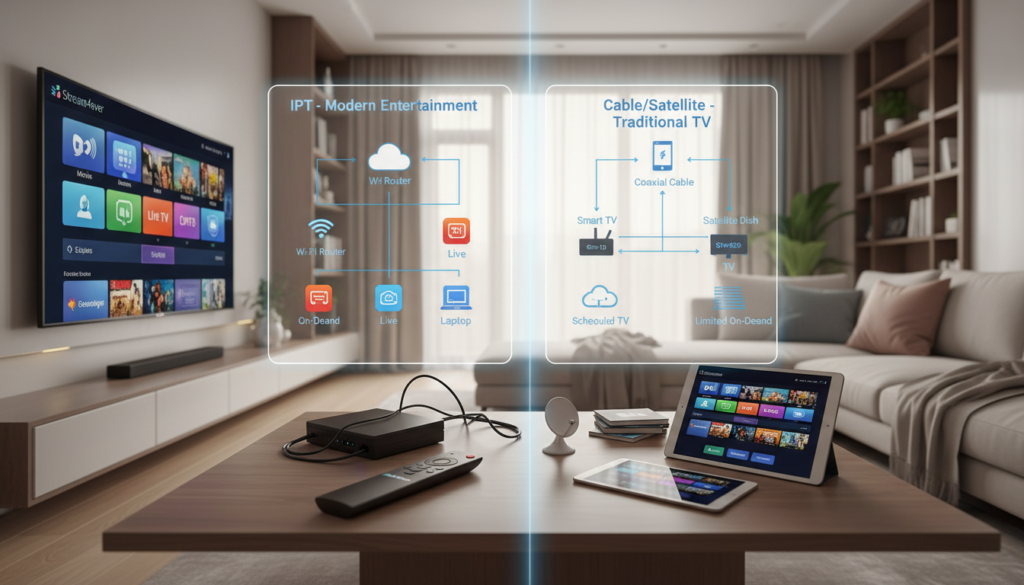
Delivery Method: Internet vs. Traditional Broadcast
Traditional cable and satellite television rely on dedicated, one-way broadcast systems. Cable uses a network of coaxial cables installed in your neighborhood. Satellite beams signals from space to a dish on your roof.
These are largely passive systems. The signal is sent out, and your TV or set-top box receives it. There’s little interaction.
In contrast, modern internet-based television uses your home broadband connection. It travels over the same network as your email and web browsing. This is a packet-switched, two-way digital highway.
This internet delivery method is the game-changer. Because it’s a two-way street, your device can talk back to the service. This enables true interactivity and instant access to vast libraries.
Flexibility and Control: On-Demand vs. Scheduled Programming
The delivery method directly dictates what you can watch and when. Traditional television is linear. Channels broadcast shows on a fixed schedule. You must be there to watch, or you must record it.
Your viewing life revolves around their timetable. This is the old way.
Internet protocol television flips this model. While it offers live channels, its superpower is on-demand content. You choose what to watch from a massive menu of movies, series, and shows.
You press play when you’re ready. This is the essence of control. This streaming model also allows for features like pausing live TV and watching shows that aired days ago.
You are no longer a passive viewer. You are the director of your own entertainment schedule.
| Feature | IPTV (Internet-Based) | Traditional Cable | Traditional Satellite |
|---|---|---|---|
| Primary Delivery | Your broadband internet connection | Coaxial cable network | Geostationary satellite signal |
| Content Control | Watch-What-You-Want, On-Demand + Live | Primarily scheduled live channels | Primarily scheduled live channels |
| Interactivity | High (Two-way communication) | Low to Moderate | Very Low |
| Device Access | Smart TV, phone, tablet, computer, streaming box | Main TV via set-top box | Main TV via satellite receiver |
| Typical Setup | App or software on compatible device | Professional installation of cable line | Professional installation of satellite dish |
| Picture Quality Potential | Up to 4K/UHD (depends on your bandwidth) | Up to 4K/UHD (can be compressed) | Up to 4K/UHD (often highly compressed) |
| Personalization | Custom channel lists, user profiles | Fixed channel bundles | Fixed channel packages |
As the table shows, the internet-based services offer a more modern feature set. The potential for higher-quality video is real, but it relies on your home internet speed.
This comparison highlights why so many people are making the switch. If you value control, flexibility, and watching on your own terms, the modern television experience is designed for you.
Exploring the Different Types of IPTV Services
Your entertainment choices expand dramatically when you understand the different service models. Not every platform delivers content in the same way.
Modern providers categorize their offerings into distinct formats. Knowing these categories helps you pick the services that match your habits.
You will typically encounter three main types. Many top-tier subscriptions blend all of them for a complete experience.
Live Linear Television
This format mirrors traditional broadcast television but uses your internet connection. Channels are streamed in real time, just like cable or satellite.
It is perfect for live events, breaking news, and sports. You get the immediacy of scheduled programming with the flexibility of streaming.
The experience feels familiar yet modern. You can access hundreds of live channels from around the world on your TV, phone, or computer.
Video on Demand (VOD) Libraries
This is a vast digital library of stored movies, series, and shows. Think of it like a Netflix catalog built into your iptv service.
You have total control. Browse the collection and press play whenever you want. There are no schedules to follow.
These vod services are ideal for binge-watching and discovering new content. The library is constantly updated with fresh titles.
Your viewing becomes a personalized movie night. It is the ultimate form of on-demand content.
Catch-Up TV and Time-Shifted Media
Missed a show that aired yesterday? This feature lets you replay it. Catch-up TV stores recently broadcast programs for a limited time.
Time-shifted media goes a step further. It often allows you to pause and rewind live streaming. You can even start a show from the beginning if you join late.
These services are frequently bundled with live TV plans. They give you the freedom to watch on your own timeline.
It eliminates the fear of missing out on your favorite programs. Your schedule no longer dictates your entertainment.
Some providers also offer near-video-on-demand for special events. This is common for pay-per-view movies or fights with staggered start times.
Understanding these types helps you evaluate providers. Do you need extensive live sports channels? Or is a deep movie library more important?
Many premium iptv services combine all three formats into one subscription. You get live TV, a huge VOD library, and robust catch-up features in a single app.
This integrated approach offers the most comprehensive and convenient content access. You can switch between live news and an on-demand movie with a single click.
How to Choose the Right IPTV Provider for You
Selecting the perfect streaming service is a critical step toward building your ideal home entertainment system. The market offers many options, but not all deliver the same value.
Your choice directly impacts your daily viewing satisfaction. A good match means endless entertainment. A poor fit leads to frustration and wasted money.
This guide walks you through the essential evaluation criteria. You will learn to compare services like a pro. Focus on three core areas: content, performance, and price.
Arm yourself with this knowledge. You can confidently pick a provider that fits your life and budget.
Evaluating Channel Lineups and Content Libraries
Start by examining what you can actually watch. A vast channel count means little if your favorite channels are missing.
Make a list of your must-haves. This often includes local broadcasters, major sports networks, news outlets, and premium movie channels. Check the provider’s list against your list.
Look beyond live TV. A deep Video on Demand (VOD) library is a huge bonus. It should be updated frequently with new movies and series.
Catch-up TV features are also valuable. They let you watch shows you missed over the past few days. This adds tremendous flexibility to your schedule.
For international viewers, check the selection of foreign-language content. A top iptv service offers a wide range of global programming.
Remember, content is king. The right library keeps everyone in your household happy.
Assessing Streaming Quality and Reliability
Even the best channel list is useless if the stream constantly buffers. Performance is non-negotiable.
Look for providers that guarantee high uptime, ideally 99.5% or more. This means their servers are almost always online and working.
Streaming quality depends on consistent bitrate. It ensures a sharp picture without pixelation. Reliable services support HD and 4K streams without constant drops.
Your home network and internet connection play a role too. But a good provider uses robust servers to minimize issues on their end.
Read user reviews specifically about buffering and lag. Consistent complaints are a major red flag.
Test customer support before you commit. Send a question and see how quickly and helpfully they respond. This indicates how they’ll handle any future problems.
A smooth, high-definition experience requires both sufficient bandwidth from your ISP and a dependable streaming partner.
Understanding Subscription Plans and Pricing
Cost is a major factor, but the cheapest option is rarely the best. You need to understand what you’re paying for.
Compare pricing tiers. Many iptv providers offer monthly, quarterly, and annual plans. Annual plans usually offer the best value but require a longer commitment.
Check for hidden fees. Are there setup costs or extra charges for premium channels? Is there a fee for using more than one screen at a time?
The number of simultaneous streams allowed is crucial. If your family watches on multiple devices, you’ll need a plan that supports that.
Look for contract flexibility. Can you cancel easily if you’re not satisfied? Avoid services with rigid long-term contracts unless you’re sure of their reliability.
Some different iptv services offer free trials. This is the best way to test the streaming quality and content before paying.
Ultimately, the goal is to access content you love at a fair price. A transparent and flexible plan from a reputable iptv provider gives you peace of mind.
Take your time with this decision. Your perfect television experience depends on it.
Essential Hardware for Your IPTV Setup
The foundation of any great home theater is built on three pillars: what you watch on, where you watch it, and how it gets there. Your viewing pleasure depends on the right combination of playback devices, a quality screen, and a robust network.
This hardware forms the backbone of your entire experience. Investing in reliable equipment prevents frustration and ensures you enjoy every show in crisp detail.
Streaming Devices: Sticks, Boxes, and Consoles
You need a capable device to decode and play your streams. This is often a small set-top box or a streaming stick that plugs into your TV’s HDMI port.
Popular options include the Amazon Fire TV Stick, Roku players, and Apple TV. These devices run apps from their respective stores, giving you access to various streaming services.
Many modern gaming consoles, like PlayStation and Xbox, also support media apps. They can double as powerful streaming boxes for your living room.
A dedicated streaming device often provides smoother performance than built-in TV apps. Look for models with sufficient processing power and memory.
The Role of Modern Smart TVs
Many televisions today are “smart” and have built-in operating systems. Brands like Samsung, LG, and Sony include app stores directly on the TV.
This means you can often download your preferred streaming app without any extra hardware. It simplifies your setup by reducing the number of devices and remotes.
However, the processing power in a TV can be limited compared to a dedicated streaming stick. Built-in apps may not receive updates as frequently.
For the best quality and experience, using an external streaming device is frequently recommended. It keeps your system fast and up-to-date.
Network Requirements: Router and Internet Speed
Your internet connection is the lifeline of your streaming setup. A weak or unstable network causes buffering and poor video quality.
You need sufficient bandwidth. For standard high-definition (HD) streams, a minimum of 5-10 Mbps is required. For 4K Ultra HD content, plan for at least 25 Mbps per stream.
Conduct a simple internet speed test to verify your home connection meets these needs. Many providers offer speed test tools on their websites.
Your router is just as important as your speed. An older router may bottleneck your fast internet plan. Consider upgrading to a modern, dual-band router.
For the most stable connection, use a wired Ethernet cable for your primary TV. This is far more reliable than Wi-Fi and eliminates wireless interference.
If you must use Wi-Fi, position your router centrally in your home. Connect your streaming device to the less congested 5GHz band for better performance.
Having the right hardware removes technical barriers. It lets you focus on what matters: enjoying a vast world of entertainment.
Critical Software: IPTV Players and Applications
Your hardware is ready, but without the right software, your screen remains a blank canvas. The applications you install act as the gateway, transforming your device into a powerful entertainment hub.
This software is your command center. It organizes live channels, on-demand libraries, and all your favorite shows into one easy-to-use interface.
Popular IPTV Apps for Various Platforms
Several excellent players dominate the market. Your choice often depends on your operating system and personal preference.
IPTV Smarters Pro is a favorite for its clean design and reliability. It works on Android, iOS, and many smart TV platforms. This app makes setting up your subscription straightforward.
Tivimate is renowned for its premium interface and robust Electronic Program Guide (EPG). It is highly customizable and is considered a top choice for Android TV devices and set-top boxes.
GSE Smart IPTV is a versatile option available on more platforms, including iOS and Android. It supports a wide range of playlist formats and includes a built-in video player.
For ultimate customization, Kodi is a powerful media center. You can install various add-ons to aggregate content from different sources. It turns a simple streaming box into a full-featured entertainment system.
Key Features to Look for in an IPTV Player
Not all players are created equal. The right features make your viewing smooth and enjoyable.
Look for these capabilities when choosing your software:
- Electronic Program Guide (EPG): A well-organized guide is essential. It shows you what’s on now and next across all your channels.
- VOD Library Support: The app should seamlessly integrate video-on-demand sections. This gives you direct access to movies and series.
- Catch-Up TV: This feature lets you watch shows that aired in the last few days. It adds great flexibility to your schedule.
- Multi-Screen & Multi-Device Support: A good player works across your phone, tablet, and TV. It should sync your favorites and watch history.
- Parental Controls: These are vital for families. They allow you to lock specific channels or content ratings.
- Recording (DVR) Capabilities: Some advanced players let you record live TV directly to your device or network storage.
- Customizable Interface: The ability to create favorite channel lists and adjust the layout improves your daily experience.
Many providers offer their own official application. These are often the safest and most stable way to use their service.
If you use a third-party player, ensure you download it from a trusted source. Sideloading apps from unknown websites can pose security risks.
For computer users, some services offer direct web browser access. You can log into your account and watch directly without any dedicated software. This is a simple and convenient way to enjoy content on your laptop or desktop.
Choosing the right player is the final step. It ensures you can navigate your vast new world of entertainment with ease and confidence.
Step-by-Step: Setting Up IPTV on Your Smart TV
Unlocking premium television on your primary screen begins with a straightforward setup process right on the device itself. Most modern smart TVs have everything you need built-in.
You just need to find and install the right application. This guide provides clear steps for the most popular brands.
Before you start, ensure your smart television is connected to your home internet. Also, have your subscription details ready. This includes your username, password, and any portal URL from your provider.
Following these instructions will have you watching in just a few minutes.
Configuration for Samsung, LG, and Sony TVs
Each TV brand has its own app store and navigation. The core steps are similar: find the store, search for the app, and install it.
Here is a detailed breakdown for each major platform.
| TV Brand & Platform | Access Point | Key Steps | Notes & Tips |
|---|---|---|---|
| Samsung Smart TV (Tizen OS) | Smart Hub | Press the Smart Hub button on your remote. Navigate to “Apps”. Use the search function to find your app (e.g., “Smart IPTV” or “IPTV Smarters”). Select “Download” and then “Install”. Launch the app from your apps menu. | Samsung’s store may not have every third-party player. Check your provider’s website for recommended apps compatible with Tizen OS. |
| LG Smart TV (webOS) | LG Content Store | Press the Home button on your remote. Select the “LG Content Store” icon. Click on “Apps” and use the search bar. Find your chosen app and click “Install”. Once installed, open it from your home screen. | webOS is a common platform. Popular players like “IPTV Smarters Pro” are often available directly in the LG Content Store. |
| Sony Android TV / Google TV | Google Play Store | From the home screen, go to “Apps”. Find and open the “Google Play Store”. Search for your IPTV app by name. Tap “Install” on the app’s page. After installation, open it from your app drawer. | This platform has the widest selection of apps. You can install almost any Android-compatible player, including provider-specific applications. |
If you cannot find a specific app, your provider may offer an .apk file for sideloading on Android TV. Always download software from official sources to ensure security.
Installing and Logging Into Your IPTV App
Once the application is on your television, the next phase is activation. Launch the app from your TV’s menu. You will likely see a welcome or setup screen.
The first-time setup usually asks for your account credentials. This is how the software connects to your chosen iptv service.
You will typically need to enter:
- Username: Provided by your streaming service.
- Password: The password for your account.
- Portal URL or M3U Link: A web address that links the app to your provider’s server. Your provider will supply this.
Enter these details carefully using your remote. Some apps offer a QR code scan option from your phone to make entry easier.
After submitting, the app will connect and load your channel list and video content library. This may take a moment.
Pro Tip: Ensure your TV’s software is up-to-date before you start. An outdated operating system can cause compatibility issues with new applications. Check for updates in your TV’s settings menu under “Support” or “About”.
If the app crashes or fails to load your channels, double-check your login information. A simple typo is a common culprit. If problems persist, contact your provider’s customer support.
Congratulations! Your main television is now a portal to live broadcasts, movies, and series. You can explore the app’s menus to find your favorite channel, browse on-demand content, and customize features like favorites.
Step-by-Step: Configuring IPTV on Streaming Devices
Your living room TV doesn’t need to be smart to access a world of streaming content. A small, affordable device can connect it to your entire entertainment library.
These dedicated players are often more powerful than built-in TV software. They receive updates more frequently and support a wider range of applications.
This guide walks you through setup on the most popular platforms. You will learn how to install the necessary software and connect to your service.
Installation on Amazon Fire TV Stick
The Amazon Fire TV Stick is a hugely popular choice. Its interface is simple and the Appstore is well-stocked.
Start by powering on your Fire Stick and connecting it to your home Wi-Fi. Navigate to the main menu and find the “Search” function.
Look for your provider’s official app by name. You can also search for generic players like “IPTV Smarters” or “Tivimate”.
Select the app from the results and click “Get” or “Download” to install it. The process is automatic and takes just a moment.
If your preferred app isn’t in the Amazon store, you can sideload it. This requires enabling a special setting.
First, go to Settings > My Fire TV > Developer Options. Turn on “Apps from Unknown Sources”.
Next, install the “Downloader” app from the Amazon Appstore. Use it to enter the web address for the app file your provider supplied.
The Downloader app will fetch and install the software. You can then launch it from your app list.
Setup on Roku, Apple TV, and Android TV Boxes
Each streaming platform has its own method. The core goal is the same: get the right application onto your device.
Here is a clear comparison of the steps for each major system.
| Device Type | App Source | Key Setup Steps |
|---|---|---|
| Roku | Roku Channel Store | From the home screen, select “Streaming Channels” to open the store. Use the search feature to find your app. Select “Add Channel” to install it. The new channel will appear on your home screen. |
| Apple TV | tvOS App Store | Open the App Store from your Apple TV’s home screen. Use the search bar or browse categories to locate the app. Click “Get” and then “Install” to download it. Launch the app from your home screen grid. |
| Android TV Box (e.g., Nvidia Shield) | Google Play Store | Go to the “Apps” section and open the Google Play Store. Search for the application you need. Tap the “Install” button on the app’s page. After installation, open it from your app drawer. |
For Android TV boxes, you can also install apps directly from a downloaded APK file. This is similar to sideloading on a Fire Stick.
You need to allow installations from unknown sources in the device settings. Then use a file manager app to locate and run the APK.
After the app is installed on any device, the next step is logging in. Open the application. You will see a setup screen asking for your details.
Enter the credentials from your provider. This usually includes a username, password, and a portal URL or M3U playlist link.
Input these carefully using your remote. Some apps offer a QR code scan option from your phone for easier entry.
Once submitted, the software will connect to the server. Your live channel list and on-demand library will load.
Remember to keep your streaming device’s firmware updated. Check for system updates in the settings menu every few months.
This ensures optimal performance, security, and compatibility with the latest app versions. Your viewing experience will be smooth and reliable.
With these steps, you can enjoy a vast selection of entertainment on any television. Simply connect a small, powerful streaming device.
How to Access IPTV on Your Computer and Mobile Devices
Your computer and mobile devices hold the key to unlocking television anywhere. The best modern services are designed for complete flexibility.
You can start a movie on your TV and finish it on your phone. Your entire entertainment library travels with you.
This section shows you how to extend your viewing beyond the living room. We cover two main paths: using your computer’s web browser and installing dedicated mobile apps.
You will learn the simplest methods to access content on any screen. Your favorite shows are always within reach.
Using Web Browser Solutions on Windows and Mac
Many providers offer a direct portal through your web browser. This is a fast and convenient way to watch.
Open Chrome, Firefox, or Safari on your Windows PC or Mac. Navigate to your provider’s website and log into your account. Look for a “Watch Online” or “Web Player” section.
This method requires no software installation. It uses your existing internet connection to stream directly in the browser tab. It’s perfect for quick viewing at your desk.
For a more app-like experience, consider a dedicated desktop app. Applications like MyIPTV Player or even VLC media player can be configured.
You typically need an M3U playlist URL from your provider. Enter this link into the software’s network stream option. It will load your live channels and on-demand content directly.
Desktop applications often provide better playback controls and stability. They are a great choice for primary computer users.
Downloading IPTV Apps for iOS and Android
Your smartphone and tablet are perfect portable televisions. The process starts in your device’s official app store.
For iOS devices like iPhones and iPads, visit the Apple App Store. For Android phones and tablets, use the Google Play Store. Search for your provider’s official app by name.
Always download from these official stores for security. Look for apps with high ratings and recent updates.
After installation, open the app. You will see a setup screen. Enter your account details like username, password, and server URL.
This links the app to your subscription. Your channel list and video library will load in seconds.
The benefits of mobile viewing are huge. You can watch live news during your commute or stream a game at the park. Some apps even let you use your phone as a remote for your TV setup.
This flexibility ensures your entertainment is never more than a tap away.
| Access Method | Best For | Key Advantages | Considerations |
|---|---|---|---|
| Web Browser (Chrome, Firefox, Safari) | Quick viewing on computers, no-installation access. | Universal compatibility, no downloads, easy login. | Dependent on browser performance; may have fewer features. |
| Desktop Application (e.g., VLC, MyIPTV Player) | Dedicated computer users wanting enhanced control. | Stable playback, advanced settings, can handle M3U links. | Requires initial setup and configuration. |
| Official Mobile App (iOS/Android) | Watching on the go, using phones/tablets anywhere. | Optimized for touch, portable, often includes remote control features. | Requires download from App Store or Play Store. |
Whether at your desk or on the move, your content is accessible. A strong network connection is vital for smooth streaming on all devices.
This multi-screen approach defines modern television. You control what you watch and where you watch it.
Why You Need a VPN for the Best IPTV Experience
Your internet service provider might be secretly slowing down your movie nights. Geographic blocks can lock you out of shows you love. A Virtual Private Network (VPN) solves these problems.
It is an essential tool for any serious streaming user. A VPN creates a secure tunnel for your data. It routes your connection through a remote server in a location you choose.
This simple action unlocks three major benefits. You gain global content access, enhanced privacy, and protection from speed throttling. Integrating a VPN transforms a restricted, buffering experience into a smooth, private, and global one.
Bypassing Geo-Restrictions and Network Blocks
Many streaming services limit their libraries based on your physical location. Your favorite home country channels might vanish when you travel. A VPN gives you a virtual passport.
By connecting to a server back home, you mask your real IP address. The service sees the VPN server’s location instead. Your full content library is restored instantly.
Network blocks are another common hurdle. Schools, workplaces, and hotels often restrict streaming traffic on their Wi-Fi. A VPN encrypts your data, making it appear as regular secure web traffic.
This allows you to circumvent these filters. You can enjoy your entertainment anywhere, on any network. It is the key to consistent, unrestricted access.
Enhancing Privacy and Security While Streaming
Your online activity is more visible than you think. Your Internet Service Provider (ISP) can see every site you visit and stream you watch. This data can be sold or used for targeted advertising.
A VPN adds a powerful layer of encryption. It scrambles your data before it leaves your device. Your ISP only sees an encrypted connection to a VPN server.
They cannot see that you are streaming video or what you are watching. This protects your personal viewing habits from prying eyes. It is crucial for maintaining digital privacy.
Public Wi-Fi networks in cafes or airports are notoriously insecure. Using a VPN on these networks is a must. It prevents hackers on the same network from intercepting your login credentials or data.
Your security and anonymity become a top priority. You gain peace of mind every time you press play.
Preventing ISP Throttling for Smoother Playback
Internet Service Providers sometimes engage in “bandwidth throttling.” They intentionally slow down your connection when they detect high data-use activities like streaming video.
This often happens during peak evening hours. The result is constant buffering and poor video quality, even with a fast plan. A VPN effectively prevents this.
The encryption hides the nature of your internet traffic. Your ISP cannot easily identify it as streaming data. Your connection is treated as generic, encrypted traffic.
This typically bypasses the throttling algorithms. Your available bandwidth is used fully, leading to smoother, higher-quality playback. It ensures you get the speed you pay for.
| Factor | Streaming Without a VPN | Streaming With a VPN |
|---|---|---|
| Content Access | Limited by your geographic location; libraries can shrink when traveling. | Global access; connect to servers worldwide to unlock regional libraries. |
| Network Freedom | Subject to blocks on school, work, or hotel Wi-Fi networks. | Bypasses most network restrictions; streams on any connection. |
| Privacy from ISP | Your ISP can monitor and log your streaming activity and habits. | ISP only sees encrypted traffic to a VPN server; your activity is hidden. |
| Security on Public Wi-Fi | High risk; data is unencrypted and vulnerable to interception. | High security; all data is encrypted through a secure tunnel. |
| ISP Throttling | Likely during peak times, causing buffering and reduced quality. | Unlikely; encrypted traffic is harder for ISPs to identify and throttle. |
| Connection Speed | Can be artificially limited by your provider. | Often maintains full available bandwidth for smoother playback. |
| Overall Experience | Can be restricted, inconsistent, and less private. | Consistent, global, private, and optimized for performance. |
Choosing the right VPN is important for the best experience. Not all services are equal for high-bandwidth streaming.
Look for these key features in a provider:
- Fast Speeds: Low server load and high-bandwidth infrastructure prevent slowdowns.
- No-Logs Policy: The provider should not record or store your online activity.
- Wide Server Network: Servers in the countries whose content you want to access.
- Strong Encryption: Industry-standard protocols like OpenVPN or WireGuard.
- Multiple Device Support: Allows installation on your TV, phone, and router.
Using a VPN with your subscription is a game-changer. It protects your investment and maximizes your enjoyment. You unlock the true potential of modern television services.
How to Optimize Your Network for IPTV
Before you blame your streaming service, check the health of your own home network. A flawless viewing experience depends on a strong and stable digital foundation.
Buffering and pixelation are often symptoms of a weak connection or poor configuration. This section provides advanced tips to fine-tune your setup.
You will learn to eliminate interruptions and ensure the highest possible video quality. These steps make your network infrastructure fully support continuous high-definition streaming.
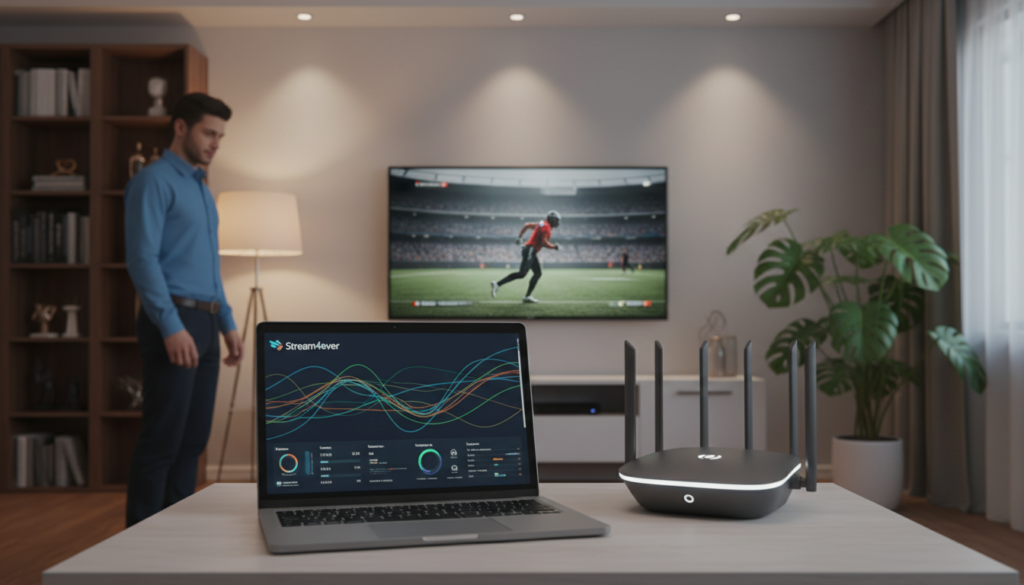
Conducting an Internet Speed Test
Start by verifying your available bandwidth. A simple speed test gives you a clear snapshot of your connection’s capability.
Visit a site like Speedtest.net using a computer connected to your main network. Click “Go” to measure three key metrics.
Download Speed is the most critical for streaming. It determines how much data can reach your device per second. For HD content, aim for at least 10-15 Mbps. For 4K streams, you need 25 Mbps or more.
Upload Speed matters less for viewing but is important for two-way communication with the server.
Ping (Latency) measures the reaction time of your connection. A low ping (under 50ms) is vital for real-time streaming. High latency causes delays between your remote click and the screen’s response.
Run the test at different times, especially during peak evening hours. This shows if your internet service provider is throttling your bandwidth. If speeds are consistently below your plan’s promise, contact your ISP.
Using Wired Ethernet Over Wi-Fi
For your primary television, a wired Ethernet connection is the gold standard. It offers greater stability and consistent speed than even the best Wi-Fi.
A physical cable creates a direct pipeline from your router to your streaming box. It eliminates wireless interference from other devices, walls, and neighboring networks.
This results in a rock-solid connection with minimal latency. It is the single most effective upgrade for preventing buffering.
If running a cable is difficult, consider powerline network adapters. They use your home’s electrical wiring to extend a wired connection to another room.
For situations where Wi-Fi is unavoidable, optimization is key. Always connect to the less congested 5GHz band on your router. Position your router centrally and elevate it for better signal distribution.
Reduce interference by keeping the router away from microwaves, cordless phones, and Bluetooth speakers.
| Feature | Wired Ethernet Connection | Wi-Fi Connection |
|---|---|---|
| Stability | Extremely high; not susceptible to radio interference. | Variable; can be affected by distance, obstacles, and other wireless signals. |
| Speed Consistency | Consistently delivers the full bandwidth of your plan. | Speeds can fluctuate significantly based on environmental factors. |
| Latency (Ping) | Very low and consistent, ideal for real-time streaming. | Generally higher and more variable than wired. |
| Security | High; data travels over a private physical cable. | Lower; signals can potentially be intercepted if not properly encrypted. |
| Convenience | Requires running a cable, which can be unsightly or difficult. | Offers complete mobility and easy setup for any device. |
| Best Use Case | Primary streaming device (living room TV, gaming console). | Mobile devices, tablets, and TVs where wiring is impossible. |
Optimizing Router Settings for Streaming
Your router’s configuration holds powerful tools for prioritizing entertainment traffic. Access its settings by typing its IP address into a web browser.
Look for a feature called Quality of Service (QoS). This lets you prioritize traffic to your specific streaming device over other activities on the network.
You can assign a higher priority to your set-top box’s MAC or IP address. This ensures video packets get through first, even when someone else is downloading a large file.
Next, check for and install any available firmware updates for your router. Manufacturers release updates to fix bugs, improve stability, and enhance security.
Consider your router’s age and standard. A modern Wi-Fi 6 router handles multiple high-bandwidth streams more efficiently than older models.
For large homes with dead zones, a mesh network system is a great investment. It uses multiple satellite units to blanket your entire space with a strong, seamless signal.
These optimizations ensure your home network is no longer the weak link. You create a dedicated highway for your entertainment, resulting in a smooth, buffer-free experience.
Top Tips to Enhance Your IPTV Viewing Experience
Mastering a few advanced features can turn a good streaming service into your ultimate entertainment command center. The real power lies not just in access to thousands of shows, but in how you organize and control them.
These pro tips move you beyond basic setup. You will learn to tailor the entire viewing experience to your household’s unique habits.
Personalization is the key to effortless enjoyment. Let’s explore the tools that put you in complete command.
Curating Your Channel Favorites and Guides
Scrolling through hundreds of channels wastes time. The solution is to create a personalized favorites list. This feature is available in almost every modern streaming app.
Simply browse your live channel list and mark your regular stations. You can often create multiple groups for different family members or moods. This creates a shortcut to the content you love most.
Your Electronic Program Guide (EPG) is more than a schedule. Use it to browse upcoming programs days in advance. Set reminders for can’t-miss events so your app notifies you.
Many guides let you filter by genre or search for specific shows. This transforms the EPG from a simple list into a powerful discovery tool. Your viewing becomes intentional and efficient.
Utilizing DVR and Recording Features
Never miss a live game or episode again. Digital Video Recording (DVR) is a game-changer for busy schedules. Modern services offer two main ways to record.
Cloud DVR stores your recordings on your provider‘s remote servers. There is no need for extra hardware at home. You can typically access these recordings from any device.
Local DVR saves files directly to an external USB drive connected to your streaming box. This gives you physical control over your recordings. It does not rely on your internet connection for playback.
To use it, find the show in your program guide and select “Record.” You can often set series recordings to capture every new episode automatically. This feature truly frees you from the broadcast clock.
Adjusting Playback and Quality Settings
Buffering can ruin a great movie night. Before blaming your internet, check your player’s settings. Most applications have a quality selector, often set to “Auto” by default.
If you experience constant stuttering, try manually lowering the stream quality. Selecting 720p instead of 1080p can create a stable picture. You can raise it again once your network is less busy.
For advanced users, some players allow you to change the video buffer size. Increasing this buffer can pre-load more data and prevent interruptions. You can also select an alternative video player engine within the app.
Exploring the settings menu unlocks hidden potential. You might find options for audio sync, subtitle styling, and aspect ratio control.
Don’t forget about household management tools. Set up parental controls to restrict certain channels or content ratings. Create separate user profiles so recommendations stay relevant for each viewer.
Your on-demand content library also benefits from organization. Add movies to a watchlist for later. These small acts of curation make your television experience feel uniquely yours.
By mastering these tips, you move from passive watching to active commanding. Your streaming service transforms into a perfectly tailored entertainment hub for your home.
Troubleshooting Common IPTV Problems
When your screen freezes or an error message pops up, don’t panic—a quick diagnostic checklist can get you back on track. Even the most reliable digital services can have occasional hiccups.
This section acts as your practical self-help manual. You will learn a systematic approach to diagnose and fix the most frequent issues yourself.
Arming yourself with this knowledge saves time and frustration. You can quickly restore your entertainment and get back to watching.
Fixing Buffering and Poor Streaming Quality
Constant buffering and a pixelated picture are usually signs of a network or bandwidth issue. Follow these steps to identify and solve the problem.
First, check your internet connection speed. Run a test on a computer connected to the same Wi-Fi. Ensure your download speed meets the requirements for your stream’s quality.
If speed is low, restart your router and modem. This often clears temporary glitches. Also, close other apps and devices using your network.
Reducing the number of active streams in your home can free up bandwidth. For the most stable connection, use a wired Ethernet cable instead of Wi-Fi.
If problems persist, try lowering the video resolution in your app’s settings. Switching from 4K to 1080p can stop the buffering instantly.
Resolving Connection and Authentication Errors
Messages like “Invalid login” or “Cannot connect to server” block your access. These errors often have simple solutions.
Always double-check your username and password for typos. Your login credentials are case-sensitive. If unsure, try resetting your password through your provider‘s website.
Verify your subscription is active and paid. An expired account will cause authentication failures.
Next, restart your streaming device and your router. A fresh start clears many temporary connection faults.
Check if your provider is experiencing a server outage. Visit their social media or support page for status updates. Sometimes the issue is on their end.
Ensure your app or player software is up to date. An old version may have compatibility problems.
Addressing EPG (Channel Guide) Issues
A missing or incorrect Electronic Program Guide makes finding shows difficult. The guide data comes from an external source your app connects to.
First, try a manual refresh within your app’s settings. Look for an option like “Update EPG” or “Refresh Guide.” This forces the app to fetch the latest data.
If the guide remains empty, the EPG source URL might be wrong or down. You may need to update this URL in your app’s settings.
Contact your customer support for the correct EPG link. They can provide the current address you need to enter.
As a final step, restart the application completely. Sometimes the guide data is cached and needs to be cleared.
Other common problems have straightforward fixes too. For audio-video sync issues, look for an “AV sync” or “audio delay” setting in your player.
If one specific channel fails, it could be a temporary broadcast issue. Try other channels to see if the problem is isolated.
For app crashes, ensure your device has enough storage space and memory. Clear the app’s cache from your device settings.
When to Contact Your Provider’s Support
If you’ve tried all basic steps and the issue continues, it’s time to contact customer support. Have your information ready to speed up the process.
Provide your account username, the error message you see, and the server address you use. Note what time the problem started and which device you’re on.
This helps the support team diagnose the issue faster. A good provider will have helpful support to resolve your problem.
With this knowledge, you become your own first line of tech support. You can solve most common glitches in minutes and return to your content without long interruptions.
Your viewing experience should be smooth and enjoyable. A little troubleshooting know-how keeps it that way.
Staying Safe: Legal and Security Considerations
Navigating the digital landscape requires awareness of both the incredible content available and the potential pitfalls that exist. Your entertainment upgrade should be exciting, not risky.
This section focuses on making informed choices. You will learn how to identify legitimate services and protect your personal information. A safe setup is the foundation of a great viewing experience.

Identifying Licensed vs. Unlicensed Services
The market contains both licensed and unlicensed providers. Knowing the difference protects you from significant risk.
Licensed services operate legally. They have formal agreements with broadcasters and content creators. Major telecom companies often offer these plans.
Unlicensed, or pirated, services redistribute content without permission. They often appear as incredibly cheap deals with huge channel lists. These are illegal operations.
Using an unlicensed provider carries serious dangers. The streams can be unreliable and shut down without warning. More critically, these platforms may harbor malware designed to steal your data.
There is also a potential for legal repercussions for users in some regions. Your goal is to enjoy streaming, not deal with these headaches.
| Aspect | Licensed, Legitimate Provider | Unlicensed, Pirated Service |
|---|---|---|
| Legal Status | Fully legal; has distribution rights from content owners. | Illegal; operates without copyright permission. |
| Content Source | Direct from official broadcasters and studios. | Often re-streams or captures signals illegally. |
| Reliability & Uptime | High; professional infrastructure with customer support. | Very low; frequent downtime and server drops. |
| Security Risk | Low; uses official apps and secure payment gateways. | Very high; risk of malware, data theft, and credit card fraud. |
| Payment Methods | Credit cards, PayPal, other traceable/secure options. | Often only cryptocurrency or gift cards to avoid detection. |
| Company Transparency | Clear company information, contact details, and terms of service. | Anonymous; no real company name, address, or contact info. |
| Longevity | Stable business model; service is likely to continue. | High risk of sudden, permanent shutdown by authorities. |
Protecting Your Personal Data and Payment Information
Your security is paramount. Follow these guidelines to shield your finances and identity.
First, only engage with reputable providers. Look for an official website with clear “About Us” and “Contact” pages. Legitimate companies are not afraid to share who they are.
Use secure payment methods. Credit cards and PayPal offer purchase protection. Be extremely wary of any provider that only accepts cryptocurrency or wire transfers.
Never save your payment details within an unofficial app. Enter them manually each time if necessary. This limits exposure if the app is compromised.
Create a strong, unique password for your streaming account. Do not reuse passwords from your email or bank. A password manager can help you track them all.
Using a VPN adds a powerful layer of privacy. It encrypts your connection, hiding your activity from your internet provider. This is especially important on public networks.
Remember, regional copyright laws affect content availability. A licensed service will reflect these laws in its channel lineup. If a deal seems too good to be true, it usually is.
Looking to get the best out of IPTV streaming? The Amazon Fire TV Stick is one of the most popular and affordable devices for smooth, high-quality streaming. It supports HD and 4K content, works perfectly with IPTV apps like Smarters Pro, and offers a fast, user-friendly interface.
Making safe, legal choices ensures your upgrade is seamless and worry-free. You can then focus entirely on enjoying your new world of entertainment.
Conclusion: Embracing the Future of Television
Stepping into the future of television means leaving behind rigid schedules. Internet protocol television has empowered you with a world tailored to your preferences. You have explored a transformative journey from passive viewing to active commanding.
The key advantages are clear. You gain control over what you watch and when. A global selection of content is at your fingertips. You can enjoy it on any screen in your home.
Choosing a reliable provider and optimizing your setup ensures a smooth experience. Tools like VPNs enhance privacy and access. This technology will evolve with higher resolutions and smarter features.
Take this knowledge and confidently step forward. This modern way of consuming media puts you in complete command. The future of television is personalized, on-demand, and streamed directly to you.
If you want to explore more advanced streaming options, check our detailed guide on IPTV OTT providers to discover the best services available today.